A business can have good people, growing revenue and plenty of activity — and still struggle to scale.
One of the clearest signs is this:
Too much keeps coming back to the same person.
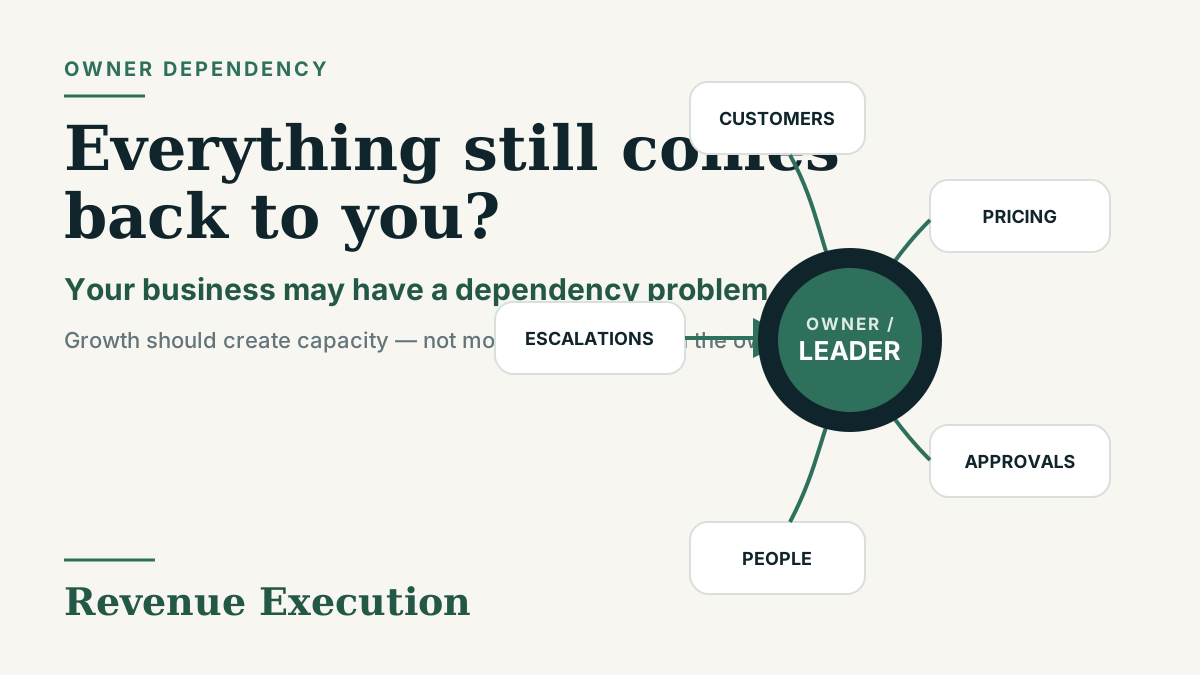
A customer issue needs approval. A proposal needs checking. A price needs sign-off. A team member wants a decision. A supplier problem escalates. A key client asks for the owner. A manager is unsure what they are allowed to decide.
Individually, none of these things looks serious.
Together, they create a business that can only move as fast as one person can think, decide and respond.
That person is often the owner or business leader.
And the problem is not simply that they are too busy.
The business has developed a dependency on them.
Being involved is not the same as being the bottleneck
Owners should be involved in important decisions. Leadership matters. Judgment matters. Experience matters.
The issue starts when normal business activity cannot progress without the leader's intervention.
There is a difference between choosing where the business is going and approving every step along the way; managing important customer relationships and being required to rescue routine customer issues; setting commercial guardrails and signing off every price or proposal.
If too many processes stop when the leader is unavailable, the business has created a structural bottleneck.
Why this often gets worse as the business grows
In the early stages, owner dependency is often useful.
The owner knows the customers, understands the offer better than anyone, makes quick decisions and carries knowledge that has not yet been distributed.
That can make a small business fast.
But the same behaviour becomes a constraint when the company grows.
- More customers create more exceptions.
- More employees create more decisions.
- More revenue creates more commercial risk.
- More activity creates more handoffs.
If the operating model does not change, all of that additional complexity flows back toward the same person.
The business grows. The leader's available time does not.
Eventually, the owner becomes the point where work queues up.
“I need better people” may be the wrong diagnosis
When this happens, the first conclusion is often that the team is not strong enough.
Sometimes that is true. But it is a dangerous assumption to make without looking at the process around them.
People can appear weak when they are operating inside a system that gives them responsibility without authority.
A manager may technically own a function but still need approval for every non-standard decision. A salesperson may own a deal but be unable to agree commercial terms without the founder. A customer lead may own the account but know the customer will bypass them and call the owner if something goes wrong.
In that environment, people learn to escalate.
The leader then sees the escalation as proof that the team cannot operate independently.
The dependency reinforces itself.
Work backwards from the owner outcome
The useful question is not:
“How do I get less involved?”
It is:
“Where is my involvement preventing the business from operating at the level it needs to?”
Start with the owner goal. Perhaps the goal is to grow revenue without adding another 20 hours to the owner's week, make the management team genuinely accountable, create a business that can operate while the owner is away, or prepare for succession.
Then identify the metric that would show progress.
- percentage of routine decisions made without owner involvement
- number of customer escalations reaching the owner
- percentage of proposals requiring founder approval
- time taken to approve pricing or exceptions
- number of processes where the owner is a mandatory step
From there, examine the processes producing those outcomes.
Where does the dependency actually sit?
Owner dependency is rarely solved by simply telling people to “take more ownership.”
Decision rights
People do not know what they can decide, where the limits are, or when escalation is genuinely required.
Process ownership
A process exists, but nobody other than the owner is clearly accountable for the result.
Information
The leader holds knowledge that other people need in order to make a good decision.
Capability
The team genuinely lacks the skill, confidence or commercial judgment required.
Management discipline
Responsibilities may be clear on paper, but managers are not being held to consistent standards, measures and review rhythms.
Each problem requires a different response.
Delegating harder does not fix unclear decision rights. Hiring another person does not fix information trapped in the founder's head. Documenting a process does not fix a capability problem. Installing software does not fix unclear accountability.
That is why diagnosis matters.
The objective is not to remove the owner
A stronger business does not mean an absent owner.
It means the owner's time is being used where it creates the most value.
The owner should be spending time on direction, important relationships, capital allocation, major people decisions and the few commercial issues where their involvement materially improves the result.
They should not be the default routing point for routine work.
The goal is not less leadership. It is less unnecessary dependency.
A simple test
Take the last two weeks and list every issue that came back to the owner or business leader for a decision.
- Should this have required the leader at all?
- If not, why did it reach them?
- What information, authority or capability was missing?
- What would need to change for the next similar decision to be handled without escalation?
Do this across enough decisions and a pattern usually appears.
That pattern is far more useful than simply concluding that the owner is too busy or the team needs to step up.
Because once you can see where the dependency is being created, you can start to remove it.
A scalable business should gain capacity as it grows. It should not make every additional customer, employee and decision more dependent on one person.